

Brinell hardness testing is a well - established and widely used method for determining the hardness of materials. As a supplier of Brinell Hardness Testers, understanding the international standards for this testing is crucial. It not only ensures the accuracy and reliability of the test results but also helps our customers make informed decisions when it comes to choosing the right equipment for their specific needs.

The Basics of Brinell Hardness Testing
Brinell hardness testing involves pressing a hard, spherical indenter into the surface of a test material under a specified load for a set period of time. The diameter of the resulting indentation is then measured, and the Brinell hardness number (BHN) is calculated using a specific formula. The principle behind this test is that a harder material will resist deformation more than a softer one, resulting in a smaller indentation diameter and a higher BHN.
The Brinell test is suitable for a wide range of materials, including metals, alloys, and some plastics. It is particularly useful for testing materials with a coarse - grained or heterogeneous structure, where other hardness testing methods may not provide accurate results.
International Standards for Brinell Hardness Testing
The most widely recognized international standard for Brinell hardness testing is ISO 6506 - 1:2014. This standard specifies the method for Brinell hardness testing of metallic materials, including the test equipment, test procedure, and calculation of the Brinell hardness number.
Test Equipment
ISO 6506 - 1:2014 defines the requirements for the indenter, which is typically a hardened steel or tungsten carbide ball. The diameter of the ball can range from 1 mm to 10 mm, depending on the material being tested and the required test load. The indenter must have a specified hardness and spherical shape to ensure accurate and reproducible results.
The testing machine used for Brinell hardness testing must also meet certain requirements. It should be capable of applying the test load accurately and maintaining it for the specified dwell time. The machine should also have a mechanism for measuring the diameter of the indentation with a high degree of precision.
Test Procedure
The standard outlines a detailed test procedure to ensure consistent and reliable results. First, the test piece must be prepared properly. The surface of the test piece should be flat, smooth, and free from any defects or contaminants that could affect the test results. The test piece should also be large enough to accommodate the indentation without any edge effects.
The test load is then selected based on the material being tested and the diameter of the indenter. The load should be applied gradually and evenly to the indenter, and it should be maintained for a specified dwell time, typically between 10 and 15 seconds for most materials. After the dwell time, the load is removed, and the diameter of the indentation is measured using a microscope or other suitable measuring device.
Calculation of the Brinell Hardness Number
The Brinell hardness number (BHN) is calculated using the following formula:
[BHN=\frac{2F}{\pi D(D - \sqrt{D^{2}-d^{2}})}]
where (F) is the test load in kilograms - force (kgf), (D) is the diameter of the indenter in millimeters (mm), and (d) is the average diameter of the indentation in millimeters (mm).
ISO 6506 - 1:2014 also provides guidelines for reporting the Brinell hardness number, including the test load, indenter diameter, and number of indentations made.
In addition to ISO 6506 - 1:2014, there are other national and international standards that may be applicable in certain regions or industries. For example, ASTM E10 is the standard test method for Brinell hardness testing of metallic materials in the United States. While there are some minor differences between ISO 6506 - 1:2014 and ASTM E10, the overall principles and requirements for Brinell hardness testing are similar.
Our Brinell Hardness Testers and Compliance with Standards
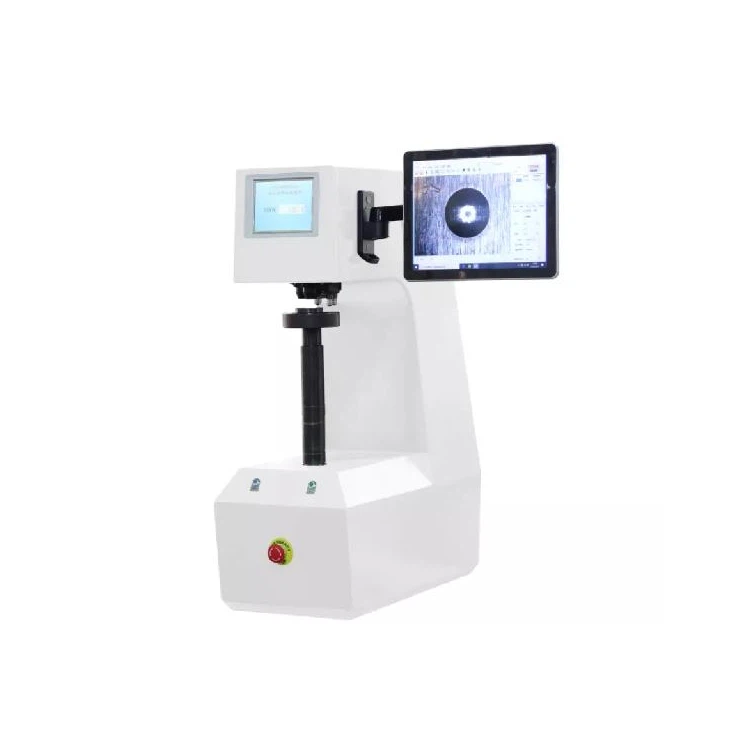
As a supplier of Brinell Hardness Testers, we are committed to providing our customers with high - quality equipment that complies with international standards. Our product range includes Small Load Brinell Hardness Tester, Electronic Digital Brinell Hardness Tester, and Automatic Brinell Hardness Tester.
Our Small Load Brinell Hardness Tester is designed for testing small or thin test pieces, where a lower test load is required. It is equipped with a precision indenter and a high - resolution measuring system to ensure accurate and reliable results.
The Electronic Digital Brinell Hardness Tester features a digital display that shows the test load, indentation diameter, and Brinell hardness number directly. It also has a built - in memory for storing test results, making it easy to analyze and report the data.
Our Automatic Brinell Hardness Tester is a fully automated system that can perform multiple tests in a short period of time. It is suitable for high - volume testing applications and can significantly improve the efficiency of the testing process.
All of our Brinell Hardness Testers are designed and manufactured in accordance with ISO 6506 - 1:2014 and other relevant standards. We also provide calibration and maintenance services to ensure that our equipment continues to perform accurately and reliably over time.
Importance of Compliance with International Standards
Compliance with international standards for Brinell hardness testing is essential for several reasons. Firstly, it ensures the accuracy and reliability of the test results. By following the standard test procedure and using equipment that meets the specified requirements, we can minimize the sources of error and obtain consistent and comparable results.
Secondly, compliance with standards is often a requirement for quality control and certification in many industries. For example, in the aerospace and automotive industries, materials used in critical components must meet specific hardness requirements to ensure their safety and performance. By using Brinell hardness testing equipment that complies with international standards, manufacturers can demonstrate that their products meet these requirements.
Finally, compliance with standards helps to promote international trade. When products are tested using a common set of standards, it is easier for buyers and sellers to compare the quality of different products and make informed purchasing decisions.
Conclusion
In conclusion, the international standard for Brinell hardness testing, such as ISO 6506 - 1:2014, plays a vital role in ensuring the accuracy and reliability of hardness testing results. As a supplier of Brinell Hardness Testers, we understand the importance of compliance with these standards and are committed to providing our customers with high - quality equipment that meets or exceeds the requirements.
If you are in the market for a Brinell Hardness Tester, we invite you to contact us for more information. Our team of experts can help you choose the right equipment for your specific needs and provide you with the support and service you require. Whether you are a small - scale laboratory or a large - scale manufacturing facility, we have the solution for you.
References
- ISO 6506 - 1:2014, Metallic materials - Brinell hardness test - Part 1: Test method.
- ASTM E10 - 18, Standard Test Method for Brinell Hardness of Metallic Materials.