

Hey there! I'm an expert from a supplier of Brinell Hardness Testers. Today, I'm gonna share with you how to test the hardness of curved surfaces using a Brinell Hardness Tester.
First off, let's understand what the Brinell hardness test is all about. It's a well - known method for measuring the hardness of materials. The basic principle is to press a hard ball (usually made of steel or tungsten carbide) into the surface of the material under a specific load for a set period. The size of the indentation left on the surface is then measured, and based on that measurement, the Brinell hardness number (BHN) is calculated.
Now, when it comes to curved surfaces, things get a bit trickier. But don't worry, with the right approach and our top - notch Brinell Hardness Testers, it can be done accurately.
Preparation
Before you start testing, you need to do some prep work. First, clean the curved surface thoroughly. Any dirt, oil, or debris on the surface can affect the test results. You can use a mild solvent and a clean cloth to wipe it down. Make sure the surface is completely dry before proceeding.
Next, choose the right ball indenter for your test. The size of the indenter depends on the nature of the material and the expected hardness. For softer materials, a larger ball indenter might be used, while for harder materials, a smaller one can be more appropriate. Our Touch Screen Brinell Hardness Tester comes with a variety of indenter options, allowing you to pick the one that suits your needs best.
Also, determine the appropriate test load. This is crucial as it affects the size of the indentation. Too much load can cause excessive deformation, and too little load might not give a clear and measurable indentation. Refer to the standards and guidelines related to the material you're testing. Our testers are designed to provide accurate and consistent load application, so you can have confidence in your test setup.
Positioning the Tester
Positioning is key when testing curved surfaces. Since the surface is not flat, you need to make sure the indenter is perpendicular to the surface at the point of contact. You can use a special fixture or adaptor that can adjust to the curvature of the surface. Some of our Electronic Digital Brinell Hardness Tester models come with advanced positioning features to help you achieve this easily.
Once the indenter is in the right position, gently lower the indenter onto the curved surface. Make sure there is no sudden impact as this can cause inaccurate results. The tester will then apply the pre - determined load for the specified time. Most of our testers have an automatic loading and holding function, which ensures that the load is applied evenly and for the correct duration.
Measuring the Indentation
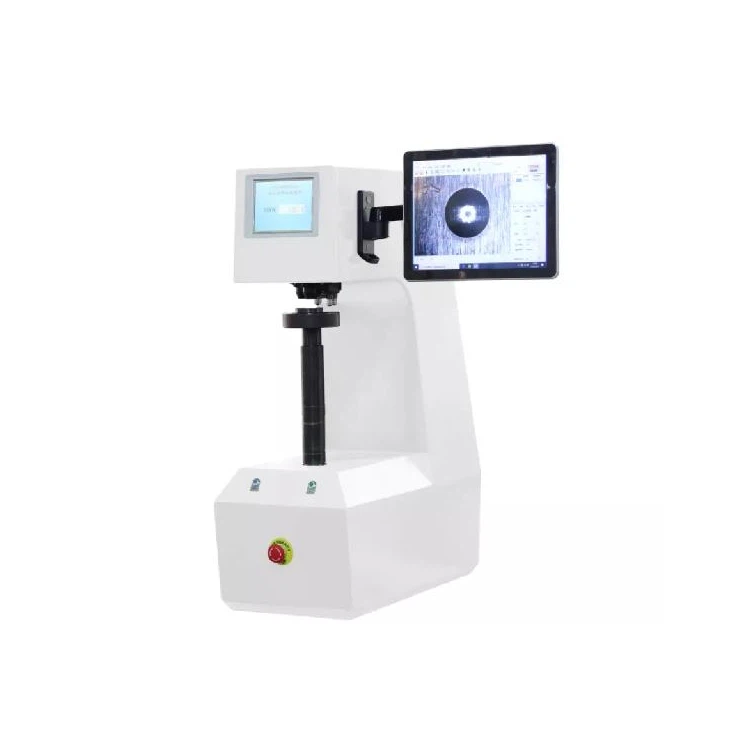
After the load is removed, it's time to measure the indentation. This can be a bit challenging on a curved surface. You can use a magnifying glass or a microscope with a measuring scale to measure the diameter of the indentation. Some of our Automatic Brinell Hardness Tester models are equipped with digital measurement systems that can automatically measure the indentation diameter and calculate the Brinell hardness number for you. This not only saves time but also reduces the chance of human error.
When measuring the indentation on a curved surface, take multiple measurements at different angles and positions around the indentation. This is because the curvature can cause the indentation to appear distorted. By taking multiple measurements and calculating the average, you can get a more accurate result.

Calculating the Brinell Hardness Number
Once you have the average diameter of the indentation, you can calculate the Brinell hardness number. The formula for calculating the BHN is:
[BHN=\frac{2P}{\pi D(D - \sqrt{D^{2}-d^{2}})}]
where (P) is the applied load in kilograms, (D) is the diameter of the indenter in millimeters, and (d) is the average diameter of the indentation in millimeters.
However, if you're using one of our automatic testers, you don't have to worry about doing the calculations manually. The tester will do it for you and display the result on the screen.
Challenges and Solutions
Testing the hardness of curved surfaces with a Brinell Hardness Tester does come with some challenges. One of the main challenges is getting an accurate measurement of the indentation due to the curvature. As mentioned earlier, taking multiple measurements and using digital measurement systems can help overcome this problem.
Another challenge is ensuring that the indenter makes proper contact with the curved surface. This is where using the right fixtures and adaptors is crucial. Our team can provide you with advice on the best fixtures and adaptors for your specific testing needs.
Why Choose Our Brinell Hardness Testers?
Our Brinell Hardness Testers are designed with the latest technology to ensure accurate and reliable results, even when testing curved surfaces. They are easy to use, with user - friendly interfaces that make the testing process a breeze. Whether you're a small - scale workshop or a large - scale manufacturing plant, our testers can meet your requirements.
We also offer excellent customer support. If you have any questions or run into any issues during the testing process, our team of experts is always ready to help.
If you're in the market for a Brinell Hardness Tester for testing curved surfaces or any other applications, we'd love to have a chat with you. Get in touch with us to discuss your specific needs and find the perfect tester for your business.
References
- ASTM E10 - 18a, Standard Test Method for Brinell Hardness of Metallic Materials
- ISO 6506 - 1:2014, Metallic materials — Brinell hardness test — Part 1: Test method